The Divine Self: Awakening the Deity Within

What if the divine we seek in the Otherworld is also waiting to be discovered within us?

There is a particular kind of spiritual longing that is difficult to explain. It isn't necessarily a longing for God. Or a particular deity. Or even a spirit beloved.
Sometimes it feels more like a longing to become more fully yourself—to uncover some deeper identity that seems to exist beneath the personality you present to the world.
Who are you when you aren't performing?
Who are you beneath the conditioning, expectations, fears, and stories you've inherited?
And what if that deeper Self isn't merely a psychological construct, but something sacred?
After years of researching spirit marriage, I began to wonder whether the relationships we develop with Otherworldly beings might be part of a larger process: the discovery and embodiment of what I call the Divine Self.
The Divine Within
The idea that divinity can be encountered within the human being isn't particularly new. Pagan scholar and Wiccan priestess Dr. Vivianne Crowley describes spiritual development as a process of discovering an inner Divine core and bringing the everyday personality into relationship with it. In her framing, this inward journey is part of the mystical project of becoming more fully who we are.
This idea also has a long relationship with psychology. Carl Jung called the process of becoming who we truly are individuation. In transpersonal psychology, related concepts have appeared under names such as the Higher Self, Universal Self, and Unique Self.

Different traditions use different maps. But many of them seem to be pointing toward a similar territory: there is more to the human being than the everyday ego.
My own research into spirit marriage led me into this territory almost by accident. I initially approached spirit marriage as a phenomenon involving relationships between human beings and Otherworldly entities. But as I listened to the stories of my co-researchers—and examined my own experiences—the boundaries between “spirit” and “Self” became increasingly difficult to draw.
I began asking a different question: What if spirit marriage isn't always about marrying something outside of ourselves? What if it can also involve union with the Divine Self?
Enter Entheosis
For the purposes of my research, I use the term entheosis to describe this process. The word comes from the Greek en-theos, meaning “God within.”
In my formulation, entheosis is a spiritual process that connects an individual with a divine or rarified aspect of themselves, bringing ordinary human consciousness into greater awareness and dialogue with that transpersonal aspect. At its fullest expression, it may involve actually embodying that consciousness as a way of being in the world.
But there's an important caveat here. I don't use “divine” to mean perfect. In fact, I think that definition creates some serious problems.
If being divine means becoming omniscient, omnipotent, and incapable of error, then we're setting up a rather ridiculous standard for human spiritual development. Worse, we're creating fertile ground for spiritual narcissism and claims of enlightenment that don't withstand much scrutiny.
Instead, I propose something much more grounded: The divine human is the fully realized potential of an individual or group devoted to the greater good of themselves and their community.
To awaken the Divine within is not to stop being human. It is to become more fully human, while entering into conscious relationship with one's deepest and highest potential.
My research led me to see connections between this idea and several Western concepts: Aristotle's entelechy, the Holy Guardian Angel of ceremonial magic, Jung's Individuated Self, and more recent transpersonal concepts of the Unique Self and Universal Self.
Different traditions. Different terminology. But perhaps a shared intuition: There is something within us that we have not yet become.
Your Divine Self Isn't Necessarily “Love and Light”
There's another misconception worth challenging. When people hear “Divine Self,” they often imagine some perfected version of themselves who is endlessly compassionate, serene, spiritually evolved, and presumably very good at drinking green juice.
I'm not buying it. The Divine Self has many flavors. Just look at mythology.
The gods and goddesses aren't all gentle, benevolent, and glowing with unconditional love. Some are fierce. Some are erotic. Some are destructive. Some are wild. Some are gender-fluid. Some are deeply transgressive.
And thank Goddess for that.
If our understanding of divinity requires us to cut off everything fierce, strange, sexual, angry, unruly, or uncomfortable, then we're not becoming more whole. We're simply becoming better at spiritual bypassing.
The goal isn't to manufacture a sanitized version of ourselves. It's to discover what OUR particular expression of the sacred actually looks like. That may require us to reclaim parts of ourselves that we've been taught are unacceptable. It may require us to descend before we can rise. And it may require us to get considerably weirder.
The Starwalker Within
One of the metaphors that has been particularly meaningful in my work comes from my mentor Orion Foxwood's understanding of the human body as a crossroads between different dimensions of consciousness.
He describes the “Star Walker” as a dimension of the Self associated with stellar powers, ancient intelligence, ancestral and Faery forces, and the deeper spiritual potentials carried within the body.
I think of the Star Walker as a useful metaphor for the Divine Self: that aspect of us carrying the blueprint of who we might become in our fullest expression. Not a blueprint for who we're supposed to be based on ancestry, fate or karma. It’s a blueprint for who we choose to be, to reveal, to discover inside of us. And that distinction matters.
Your Divine Self isn't somebody else's idea of what an enlightened person should look like. It is YOUR particular configuration of genius, vitality, eros, intelligence, creativity, devotion, ferocity, tenderness, and purpose.
The work is not to become divine. The work is to recognize the divinity already moving through you.
Divine Self, Divine Other

Here's where things get particularly interesting. If you've been following my work on spirit marriage, you might recognize the territory. Many of the traditions represented in my research have some concept of a personal deity or divine presence that relates to the practitioner in an intimate way.
In British Traditional Witchcraft, for example, Orion described his elevation to the third degree as initiating a descent of the “Godhead.” This included an experience of Divine Self embodiment that ultimately contributed to his taking a new spiritual name and later marrying his Faery wife, Brigh.
In Shakta Tantra, the search for one's ishtadevi/a, or chosen devotional deity, can involve discovering the deity as an expression of divinity through the practitioner. In Haitian Vodou and New Orleans Voodoo, the concept of the met tet involves a personal spiritual relationship that my research led me to compare with ideas such as a patron saint or guardian spirit.
And in ceremonial magic, the practitioner's Knowledge and Conversation with the Holy Guardian Angel involves a prolonged process of discovering and entering into relationship with a divine identity beyond ordinary ego consciousness.
These traditions are not interchangeable. Their practices, histories, cosmologies, and meanings are distinct. But as a comparative researcher, I became interested in a recurring theme:
What happens when human beings cultivate an intimate relationship with a consciousness they experience as more expansive than their ordinary selves?
Is the Divine Self a Spirit Marriage?
This is where my research took an unexpected turn. As I compared the experiences of my co-researchers, I noticed that some of their descriptions of their spirit-spouses sounded remarkably similar to accounts of encounters with the Holy Guardian Angel or other forms of Divine Self.
People described dialogue, signs, intuitive nudges, and a sense of being guided. They detailed a relationship with something that felt simultaneously intimate and somehow greater than the everyday personality. So I began asking: Is finding one's Divine Self actually a form of spirit marriage?
I don't think there is one universal answer. In fact, the more deeply I explored the question, the more nuanced it became.
In some traditions, there is a clear distinction between an internalized or indwelling divine relationship and marriage to an external spirit. In others, the distinction becomes considerably blurrier.
My own experience has been decidedly both-and. At first, I was falling in love with an externalized Otherworldly being. But that relationship quickly began leading me toward a deeper relationship with the Divine within. The two relationships seemed to feed each other.
The more I cultivated my own spiritual discipline and sovereignty, the more clearly my Otherworldly beloved seemed to emerge. And the more deeply I engaged with that relationship, the more it pushed me toward my own transformation.
Perhaps this is one of the great paradoxes of spirit marriage: The Other may lead us deeper into ourselves.
And sometimes, the discovery of the Self may open the door to the Other.
We Don't Have to Choose
This is one of the conclusions that has become increasingly important to me. We tend to divide spiritual experience into categories:
Inner versus Outer
Upperworld versus Underworld
Psychological versus Spiritual
Self versus Other
Human versus Divine
But experiences involving discarnate beings don't always respect those boundaries.
My research suggests that people may engage with both internal and external forms of extraordinary consciousness in order to create something new through the relationship. Spirit marriage and entheosis can both function as technologies for aligning the personality with an expanded state of perception.
Maybe the important question isn't whether the Divine Self is “really” inside us or whether a spirit is “really” outside us. Maybe the more interesting question is:
What happens to a human being when they enter into sustained, intimate relationship with something they experience as greater than their ordinary consciousness? What changes? What becomes possible? Who do they become?
Those questions don't require us to prematurely resolve the metaphysics. They invite us to pay attention to the transformation.
Becoming Who You Came Here to Be
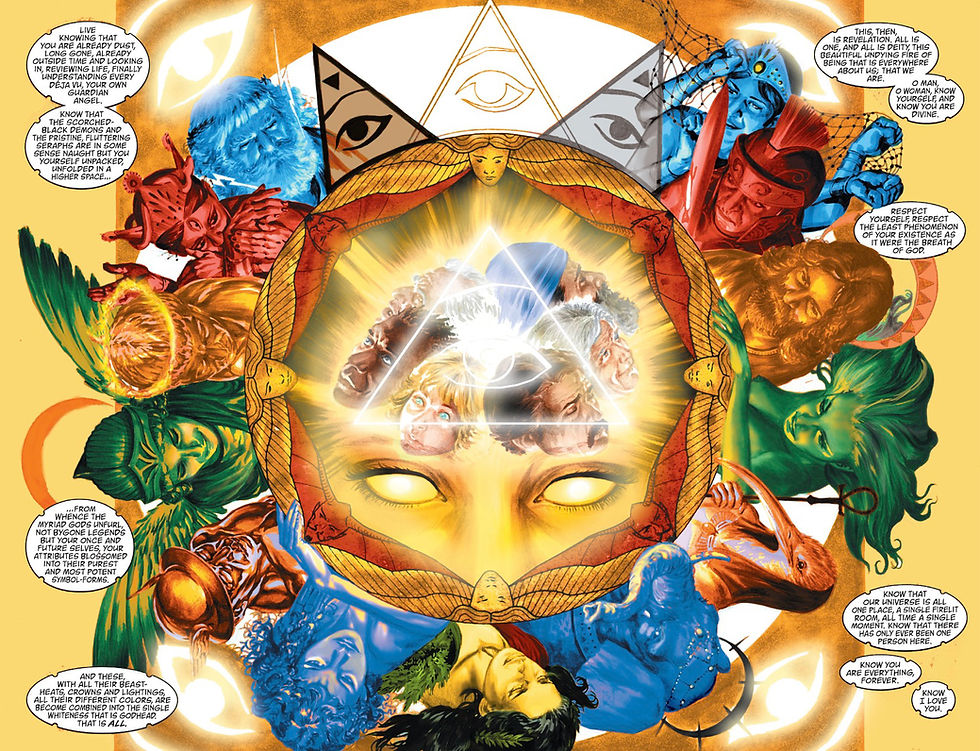
There is a concept from Jungian psychology that has stayed with me throughout this work: individuation is the process of becoming who we truly are.
Not becoming someone else. Not becoming a generic “better” person. Becoming YOU.
And perhaps spiritual awakening isn't about escaping the human condition. Perhaps it is about inhabiting it more completely.
The Divine Self isn't an excuse to transcend the messy business of being human. It asks us to bring the divine into the mess…
Into the body. Into our relationships. Into our work. Into our sexuality and creativity. Into our communities. Into the places where we are still afraid. Into the parts of ourselves we would rather pretend aren't there.
That, to me, is a much more interesting vision of spiritual development than floating serenely above the world.
I don't believe realization of the Divine Self is an extraordinary achievement reserved for a tiny handful of enlightened masters. I believe it is a potential available to all of us. Perhaps it is even our birthright.
And perhaps the real work isn't learning how to become divine. Perhaps it is learning how to recognize the divine already here—and then having the courage to embody it.


Comments